
Many companies hold SEBI approval and are waiting for the right window. The ones that use the wait well will list better.
By Amit Azad, FCA, Managing Partner & Head, Operations and Finance, Finese PR
India’s primary market has had a busy year, and a long line of companies now holds SEBI approval but hasn’t launched. Some are waiting for better valuations, some for calmer markets, and some simply for a slot when investors’ money isn’t tied up in a very large issue.
If your company is one of them, the wait is not dead time. It is the best time you will have to get ready, because once the window opens, there is little time left for anything except execution.
The bar has gone up
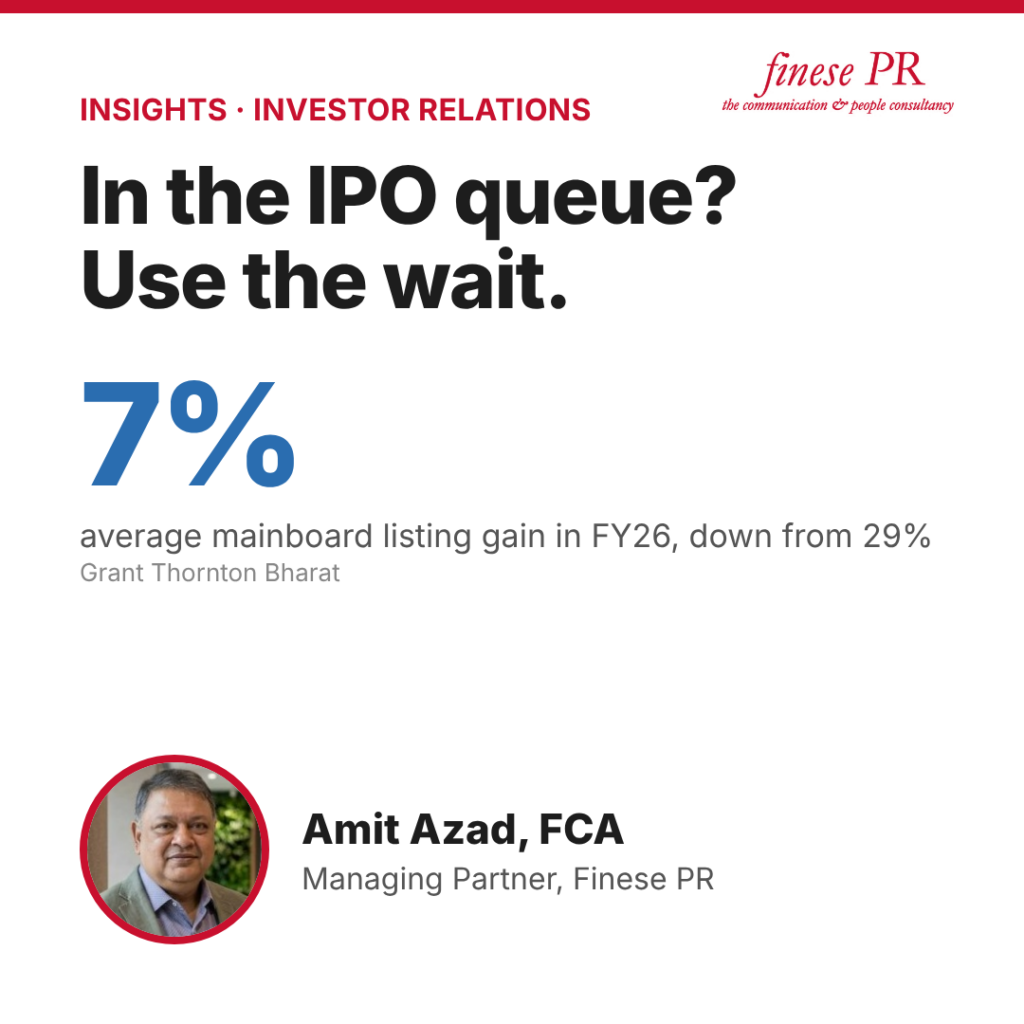
Grant Thornton Bharat’s review of FY26 shows how much has changed. 109 mainboard IPOs raised about ₹1.77 trillion, but average listing gains fell to 7%, from 29% the year before. Investors focused on valuation, governance, promoter intent, use of proceeds and institutional demand. Strong subscription did not guarantee listing gains.
Put simply, the market is no longer rewarding companies just for showing up. It is rewarding companies that explain themselves well.
Here is what I would do with the wait.
1. Keep one story, and keep it inside the offer document
Everything said in public during this period has to match the offer document and SEBI’s publicity rules. That is not a reason to say nothing. It is a reason to agree on the words now.
Bring management, the merchant bankers, legal counsel and the company secretary together and settle one fact sheet: what the company does, how it makes money, where the money from the issue goes, and the numbers that support each point. You don’t need a new story. You need the same story told clearly, by everyone, every time.
2. Prepare for the five questions investors are asking
The questions are no secret: valuation, governance, promoter intent, use of proceeds, and institutional demand. Write a plain answer to each. Then test the answers on someone who doesn’t know the company. If they can’t repeat your answer back to you, an analyst won’t either.
3. If the issue is mostly an offer for sale, say why
Offers for sale made up 61% of mainboard IPO proceeds in FY26, according to Grant Thornton Bharat. There is nothing wrong with existing shareholders selling. But investors will ask why they are selling now and what stays with the company. A clear, honest answer, prepared in advance, is far better than an awkward one in the roadshow.
4. Let the market know the business before it knows the price
Analysts and business journalists who already understand your sector and your place in it will read your offer document faster and more fairly. Within what your bankers and counsel allow, factual conversations about the industry and the business, not the issue or its price, build that understanding. Done in the last two weeks before opening, they look like marketing. Done now, they look like substance.
5. Plan for the day after listing, not just listing day
With listing gains this thin, listing day is not the finish line. The real test is your first results as a listed company. Decide now on your results calendar, the format of your earnings call, who speaks for the company, and how material information will be approved and disclosed. Companies that list with this machinery in place are rarely surprised by their first quarter as a listed company.
A word for SME issuers
The pressure is sharper in the SME segment. Grant Thornton Bharat’s data shows average SME listing gains fell to 9.8% in FY26 from 44.1% in FY25. IPOs below ₹500 crore averaged 2% listing gains, and their issue costs averaged 9.7% of the issue size. For a smaller company, a well-prepared investor story is not a luxury. It decides how much of the money raised is well spent.
When the window opens, it can open fast
Windows rarely give notice. When sentiment turns, issuers that were waiting tend to move together, and the ones that used the quiet months well are ready to walk through.
Talk to our IR desk. Finese PR’s investor relations desk is led by a Chartered Accountant with close to four decades in the financial markets. We support SME and mainboard issuers from before the offer document is filed through the first results after listing, working with merchant bankers, legal counsel and company secretaries so that messaging stays consistent with the offer document and SEBI’s publicity rules.
IPO communications: finesepr.com/services-ipo-communications.html · IR desk: finesepr.com/contact.html#ir-desk · info@finesepr.com · +91 98681 61071 (also WhatsApp) · +91 11 2702 2460
Source: Grant Thornton Bharat, “India’s IPO market: Active pipeline, sharper investor scrutiny” (FY26 data).
